"Motorola had played around with the 68000 design and decided not to go forward aggressively with that. Instead, they did the best 8-bit processor ever done, the 6809."
— Bill Gates, interview
stevenvh.net
I grew up with microprocessors. They had been available for some years — the Mother of All Microprocessors, the Intel 4004, was released in 1971 — but by the middle of the decade microprocessors became available for hobbyists, and consumer products with a microcontroller inside came to market.
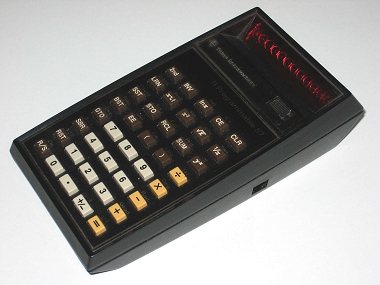
My first experience with programming was when I got a programmable calculator, the Texas Instruments TI-57, in 1977. (I had told my mom I absolutely needed it for school.) It could hold a program of maximum 50 instructions in volatile memory, i.e. your program was gone when you switched of the device. But it was a good way to learn the first steps of programming.
Later I got a TI-58, which was more advanced, and had for instance program libraries for specific tasks.
Around the time I went to college, in 1979, I started with general-purpose microprocessors, like the Zilog Z-80, and the Motorola MC6802. (Note: I'll refer to the MC6800 and MC6802 interchangeably as they have the same programming model. The MC6802 has 128 bytes of on-chip RAM, though, which is not present on the MC6800.)
The first hobbycomputers came to market. Some had their own — CRT — display unit; other had to be connected to a TV set. But all used BASIC as their programming language, which was convenient for the owner of the machine, but it also obfuscated the microcontroller inside.
I bought an experimenter board around the Z-80, which had to be programmed in machine language via a very basic (no pun intended) keypad and ditto display. Well, you wrote the program in assembly language, but you assembled the code by hand.
In college we had similar experimenter boards, but this time built around the Motorola MC6802. Once you had some experience with one microprocessor a new one didn't pose much difficulty; you just had to learn the new machine codes.
In 1980 Radio Shack (known as Tandy in Europe) released a new hobby computer, the TRS-80 Color Computer, aka COCO, in 1983 followed by a Mark II model. Radio Shack had made a rather successful TRS-80 before, built around the Zilog Z-80, but despite the similar name the Color Computer was a complete different machine. Whereas the TRS-80 had a monochrome display, with very elementary block graphics, the CoCo had color pixel graphics. I bought a Color Computer 2 in 1983. (IBM's PC had already been released in 1981, but was way too expensive for a college student like me.)
Another difference between the TRS-80 and the CoCo was the microprocessor used. Whereas the former used the Z-80, the CoCo was equipped with a Motorola MC6809, the successor of the MC6802.
There is a number of factors which determine the performance of a microprocessor. There's clock frequency, say the speed. Computers from the era were slow, typically running on a clock between 1 and 2 MHz. (Today's PCs are around 1000 times faster.)
There is the word width; the number of bits used to represent a basic information unit. The first microprocessors were 4-bit, and the TI-57 and TI-58 calculators had 4-bit cores. With four bits you can have 16 combinations, enough to represent a decimal digit. And good enough for a calculator.
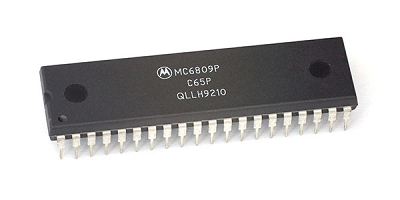
"The MC6809 has the most complete set of addressing modes available on any 8-bit microprocessor." (datasheet)
I don't know anybody who worked with the 6809 and didn't speak of it in superlatives. "Most elegant processor ever" is one I heard many times.
"Motorola had played around with the 68000 design and decided not to go forward aggressively with that. Instead, they did the best 8-bit processor ever done, the 6809."
— Bill Gates, interview
The 6809 is a remarkable microprocessor. Yes, it did have the most addressing modes of any 8-bit processor, but that's only part of its superiority in the 8-bit world. It has a very complete register set, and combined with the addressing modes and an orthogonal instruction set it has 1464 distinct instructions. Overmore, it was designed with high-level languages (C!) in mind, and allowed relocatable (position-independent) and re-entrant code. All of which allowed Microware to develop an excellent operating system for the 6809: OS-9.
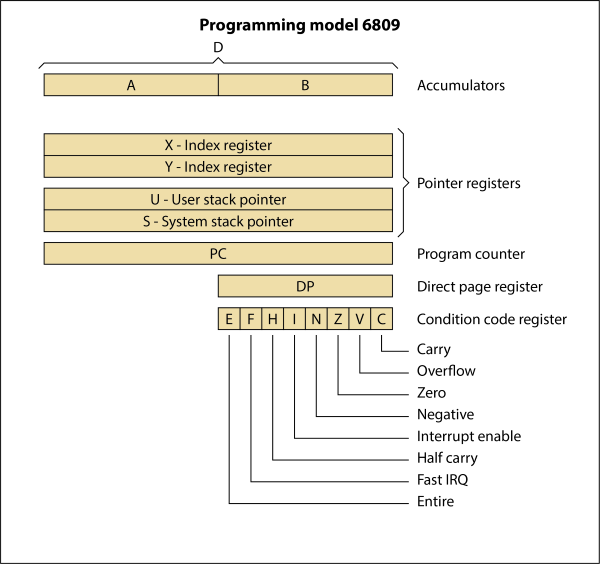
I already mentioned the programming model. The 6809 has two 16-bit index registers, and two 16-bit stack pointers, for instance. Two 8-bit accumulators which combine into a 16-bit accumulator. That makes the 6809 a hybrid of an 8-bit and a 16-bit microprocessor.
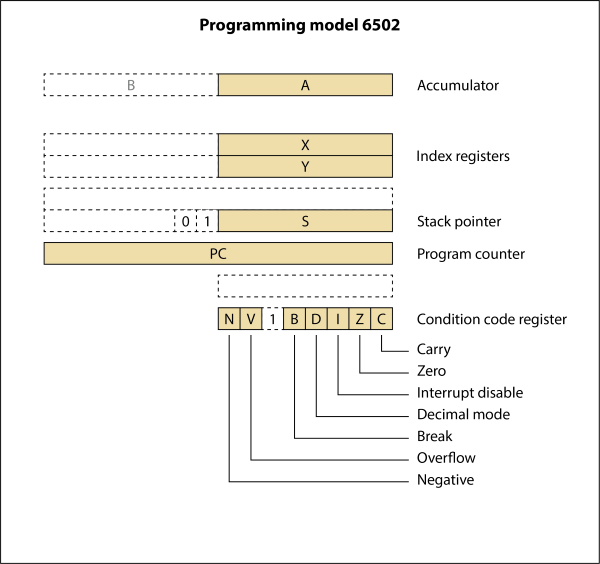
The 6502's programming model looks rather pale in comparison: all registers are only 8 bit wide, and there's only one accumulator and one stack pointer.
In the following table the 6502 and 6809 are shown side-by-side, with the MC6802 added for good measure.
| Characteristic | 6502 | 6802 | 6809 |
|---|---|---|---|
| Number of transistors | 3500 | 4000 | 9000 |
| Databus width in bits | 8 | 8 | 8 |
| Addressing range in kB | 64 | 64 | 64 |
| Addressing modes | 7[1] | 6 | 14 |
| Total instruction/addressing mode combinations | 151 | 195 | 1464 |
| Registers | 6 | 6 | 10 |
| Number of accumulators | 1 | 2 | 2 |
| Number of index registers | 1 | 1 | 2 |
| Index register width in bits | 8 | 8 | 16 |
| Number of stack pointers | 1 | 1 | 2 |
| Stack pointer width in bits | 8 | 16 | 16 |
| Direct(zero) page register | No | No | Yes |
| SEX instruction ;-) | No | No | Yes |
| Total bits in register | 55 | 71 | 112 |
| On-chip RAM in bytes | 0 | 128 | 0 |
[1] You'll often find 13 as the number of addressing modes. If you take a closer look at those 13 you'll see that MOS counts Indexed-X and Indexed-Y as separate addressing modes, which is a joke. If Motorola would count the same way the 6809 will easily reach 20 addressing modes; indeed indexing can be done on all 4 index registers and stack pointers. And it could count operations on accumulator A and B separately, for instance.
An orthogonal ISA is an architecture where register set, instruction set, and addressing modes are very much independent of each other. This means that an instruction for one register has an equivalent instruction for any other register. Unlike the 6502, the 6809 is highly orthogonal, which accounts for the large number of instruction/addressing modes. But orthogonality comes at a price: the completeness needs more transistors which results in a higher price.
| Processor | # bits | Time | Time normalized[1] |
|---|---|---|---|
| 6502 @ 1MHz | 8 | 13.9 | 13.9 |
| Z80 @ 4 MHz | 8 | 6.8 | 27.2 |
| 6809 @ 2 MHz | 8/16[2] | 5.1 | 10.2 |
| 8086 @ 8 MHz | 16 | 1.9 | 15.2 |
| 68000 @ 8 MHz | 16 | 0.49 | 3.92 |