Photography
Bokeh
A camera lens creates an image of the object on the image sensor or film. Light coming from the object goes in all directions and some will pass through the lens. When the object is in focus all the light paths from one point on the object through the lens will be refracted in such a way that they all coincide in the same point on the sensor.
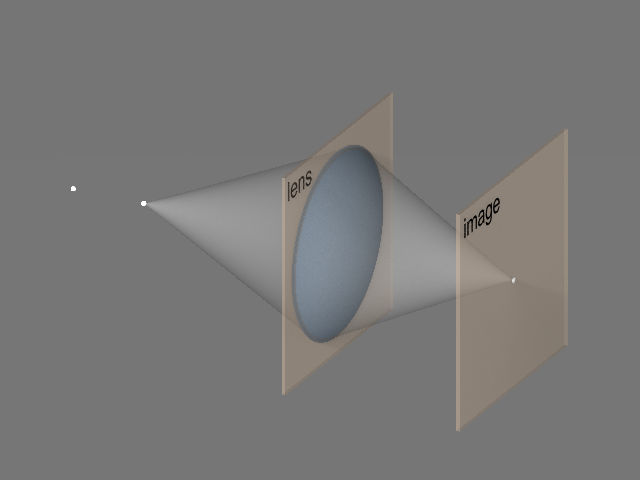
So the projection of a point is a point, and the combined points of the object form the combined points of the image.
But for objects that don't lie in the same plane it's different. Objects further away will be focused closer to the lens, as can be seen in the following diagram:
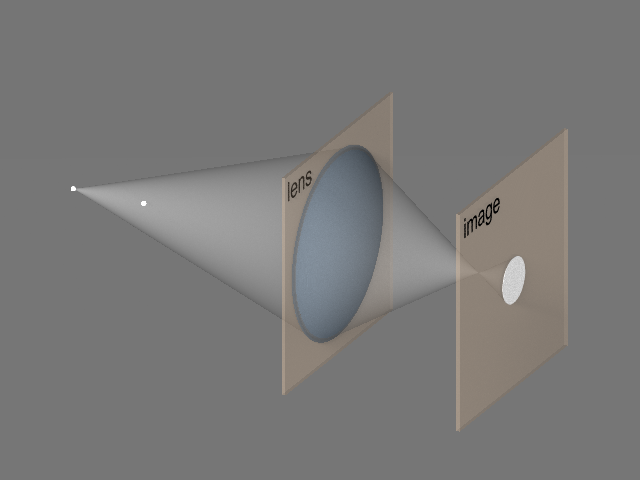
The light rays pass through the focus point and continue till they hit the sensor in the image plane. As you can see the point has become a circle. It's a circle because that's the shape of the lens. What we see is not an image of the remote object, but an image of the lens! This is known as bokeh. Bokeh shows mainly if you have one or more bright points in the unsharp background. If you have an evenly lit background all points will form their own circle in the image, and the overlapping circles will cause the fuzziness we associate with an out-of-focus background. Bright points in the background make their circles stand out, as can be seen in this image:

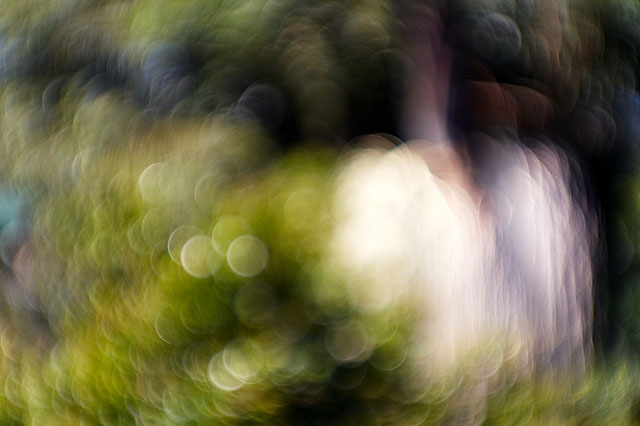
In the following image there are also bright spots, but they're less bright and there are more of them.
Variations in bokeh
As I pointed out the shapes in the image are determined by the shape of the lens. For a common refractive lens, when the diaphragm is fully open, this will be a circle. But for smaller apertures the blades often make it look like a polygon instead (heptagons are common). Also the lens construction can cause variations in bokeh; the center of the circles may be darker, or lighter than the edges. The first bokeh image shows smooth circles, and this is commonly regarded as “good bokeh”. One type of lens which particularly causes trouble is the mirror lens. Mirror lens is actually a misnomer, because the image isn't formed through the refraction of lenses, but through the reflections of convex and concave mirrors. Mirror lenses are much lighter than refraction lenses, and you can get very long focus lenses in a compact device. An 800mm mirror lens can be less than 150mm long.
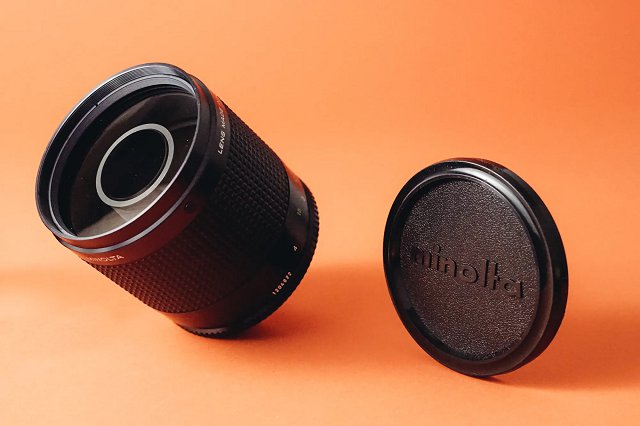
As can be seen the center of the light path is blocked by the secondary mirror of the lens. And that opaque disc in the center is the culprit: the lens shape may be a circle, but with a hole in the middle it will look more like a doughnut.

This picture (by someone named Dirk, no other information) could have been a great shot, but in my opinion is completely ruined by the bokeh. This is obviously a mirror lens shot, and bokeh from mirror lenses can be distracting. This is true for the different people in the background, but especially for the several bright doughnut spots on the boy's bermuda shorts. Mirror lenses at long focal lengths are often much cheaper as classic lenses, and that's the reason for their relative popularity. But if your picture will show bokeh it's best to avoid them as much as possible.