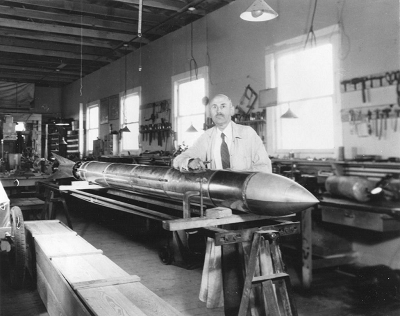
Professor Robert H. Goddard (1882-1945) was an American physicist and rocket scientist who a.o. launched the first liquid-fuel rocket in 1926. On 13 January 1920 the New York Times published a virulent and derogatory editiorial about Goddard and his work.
The focus of the critique — obviously written by somebody who flunked Physics 101 — was on the theory that a rocket would be able to accelerate in space, without an atmosphere to "push" against. (Spoiler: it can).
Below is the text of the infamous editorial.
That Professor Goddard, with his "chair" in Clark College and the countenancing of the Smithsonian Institution, does not know the relation of action to reaction, and of the need to have something better than a vacuum against which to react -- to say that would be absurd. Of course he only seems to lack the knowledge ladled out daily in high schools.
But there are such things as intentional mistakes or oversights, and, as it happens, Jules Verne, who also knew a thing or two in assorted sciences -- and had, besides, a surprising amount of profetic power -- deliberately seemed to make the same mistake that Professor Goddard seems to make. For the Frenchman, having got his travelers to or toward the moon into the desperate fix of riding a tiny satellite of the satellite, saved them from circling it forever by means of an explosion, rocket fashion, where an explosion would not have had in the slightest degree the effect of releasing them from their dreadful slavery. That was one of Verne's few scientific slips, or else it was a beliberate step aside from scientific accuracy, pardnable enough in him as a romancer, but its like is not so easily explained when made by a savant who isn't writing a novel of adventure.
All the same, if Professor Goddard's rocket attains sufficient speed before it passes out of our atmosphere -- which is a thinkable possibility -- and if its aiming takes into account all of the many deflective forces that will affect its flight, it may reach the moon. That the rocket could carry enough explosive to make on impact a flash large and bright enough to be seen from the erath by the biggest of our telescopes -- that will be believed when it is done.
The New York Times, 13 January 1920
Apparently it took the New York Times 49 years to realize the stupidity of the 1920 editorial, because the day after Apollo 11 lifted off and indeed exerted thrust in space they published following correction. (As a matter of fact they shouldn't have waited for this event. For instance the year before Apollo 8 went around the moon too, just didn't land.)
A Correction. On Jan. 13, 1920, "Topics of the Times," an editorial-page feature of The New York Times, dismissed the notion that a rocket could function in vacuum and commented on the ideas of Robert H. Goddard, the rocket pioneer, as follows:
"That Professor Goddard, with his 'chair' in Clark College and the countenancing of the Smithsonian Institution, does not know the relation of action to reaction, and of the need to have something better than a vacuum against which to react - to say that would be absurd. Of course he only seems to lack the knowledge ladled out daily in high schools."
Further investigation and experimentation have confirmed the findings of Isaac Newton in the 17th Century and it is now definitely established that a rocket can function in a vacuum as well as in an atmosphere. The Times regrets the error.
The New York Times, 17 July 1969. Apollo 11 was on its way to the moon...